We use cookies and similar technologies to help personalise content, tailor and measure ads, and provide a better experience. By clicking ‘Accept All’ or turning an option on in ‘Configure Settings’, you agree to this, as outlined in our Cookie Policy. To change preferences or withdraw consent, please configure your cookie settings.
Our Platform uses various types of cookies, each of which has a specific function. Below you can manage your preferences.
Technical Cookies
These cookies are essential to provide you with services available through this Platform and to use some of its features, such as access to secure areas. Without these cookies, services you have asked for, like transactional pages and secure login accounts, would not be possible.
Functionality Cookies
These cookies serve a variety of purposes related to the presentation, performance and functionality of this Platform. Their overall purpose, however, is to enhance visitors’ experience and enjoyment of this Platform. For example, some of these cookies enable visitors to specify language, product or other platform preferences.
Analytical Cookies
These cookies, including those from third parties, are used to collect information about how visitors use our Platform. The information gathered does not identify any individual visitor and is aggregated. It includes the number of visitors to our Platform, the platforms that referred them to our Platform and the pages that they visited on our Platform. We use this information to help run our Platform more efficiently, to gather broad demographic information and to monitor the level of activity on our Platform.
Advertising Cookies
These cookies, including those from third parties, are aimed at creating profiles related to you and are used to deliver adverts more relevant to you and your interests in line with your preferences expressed while surfing the web. They are also used to limit the number of times you see an advertisement as well as help to evaluate the effectiveness of advertising and promotion. They are usually placed by advertising networks with our permission. They remember that you have visited a platform and this information is shared with other organisations such as advertisers.
Social Cookies
These cookies are third party cookies (e.g. Facebook) that allow you to interact with social media platforms. The companies that serve these cookies may also use your information to serve targeted advertising on other platforms.
Third party cookies are cookies from sites or web servers other than our own, which are also used for the purposes of those third parties.
For more information about the cookies used on our site, their characteristics and how to manage your consent to their use, you can consult our Cookie Policy.
By clicking “Save and close” you declare that you consent to the use of cookies according to the above preferences.
By clicking "Accept all" you declare that you consent to the use of all cookies stated above.
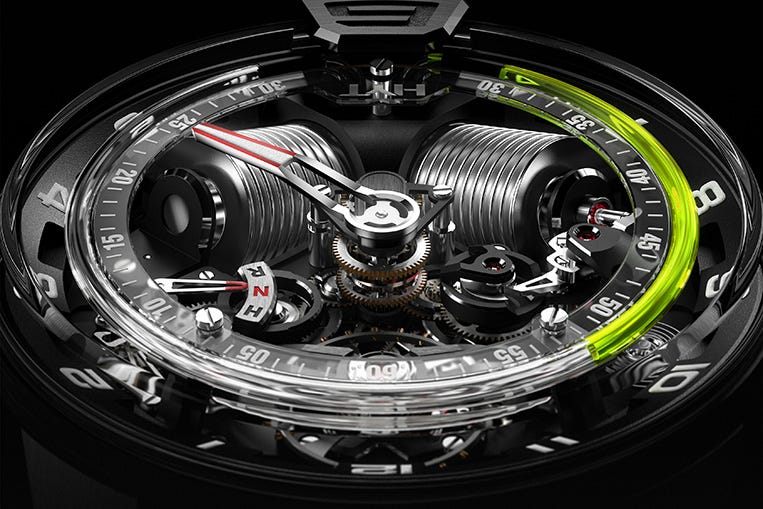
There is something of the steampunk about Vincent Perriard's HYT H1. The ambiguity of the company’s name, (which can either be pronounced ‘H-Y-T’ or as ‘hit’), alludes to a duality that is evinced in the retro-futuristic styling of the H1 and new sequel, the H2. HYT has claimed variously that the initials stand for ‘Hydro Technology’ or ‘Hydro Time’. Name aside, the fiendishly technical case is breath-taking—a marvel that appears to house breathing bellows at its core, recalling H.R.Giger’s bio-mechanical Promethean universe. Somehow, HYT has brought liquids to horology.
It is a concept that ought to be anathema to the art that sought to protect the minutiae of regulators, bridges and escapements from such forces, yet HYT are not concerned about rusting components. As with traditional watches, the mainspring barrel stores potential energy, gears regulate the release of power at a pre-determined rate, but here is where the similarity ends.
Typically it is this conversion of potential to kinetic energy that propels a minute, second and hour hand, yet the H1 is hardly a typical watch. Just look at it—it wouldn’t be out of place in the Batcave.
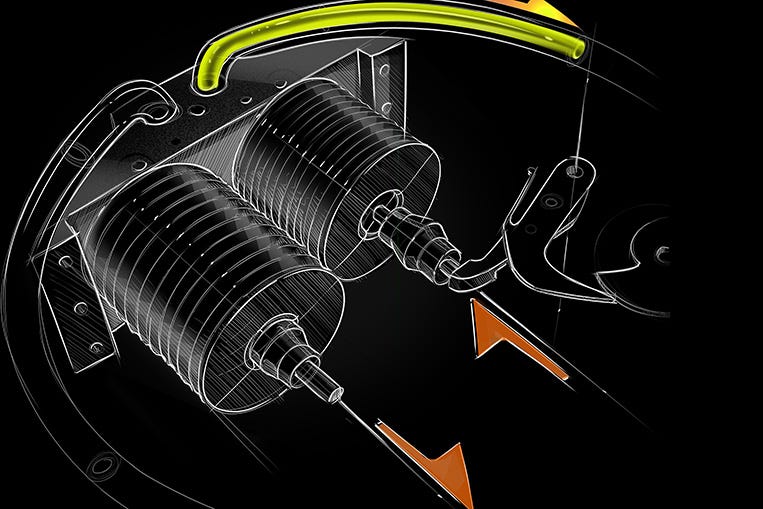
Two mechanically-actuated miniature bellows, formed from electro-deposited alloy, pump the coloured fluorescein and clear oil back and forth
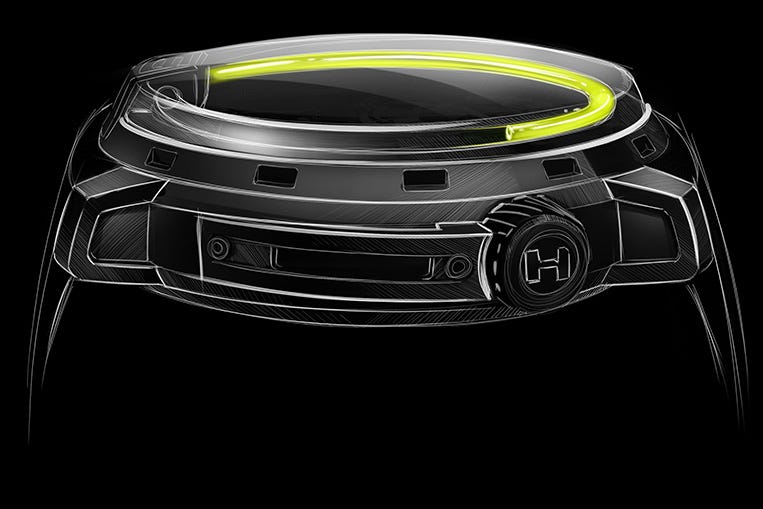
Its gears drive not hands, but neon tubes containing liquids inside—one green, one clear—to demarcate minute and hour intervals. The gears propel a cam, which pushes two pistons to inflate and compress the tiny set of bellows, which in turn drive the liquid technology. It is those intermittently respiring bellows that inspire such wonder at the centre of the titanium, DLC or rose-gold case.
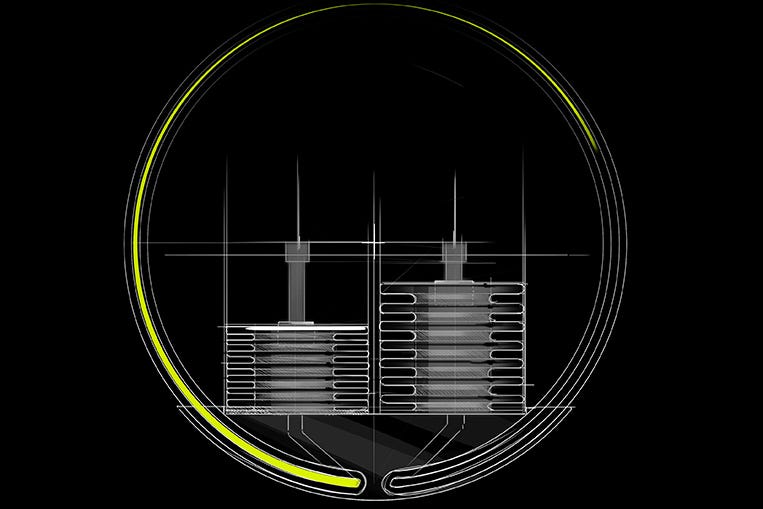
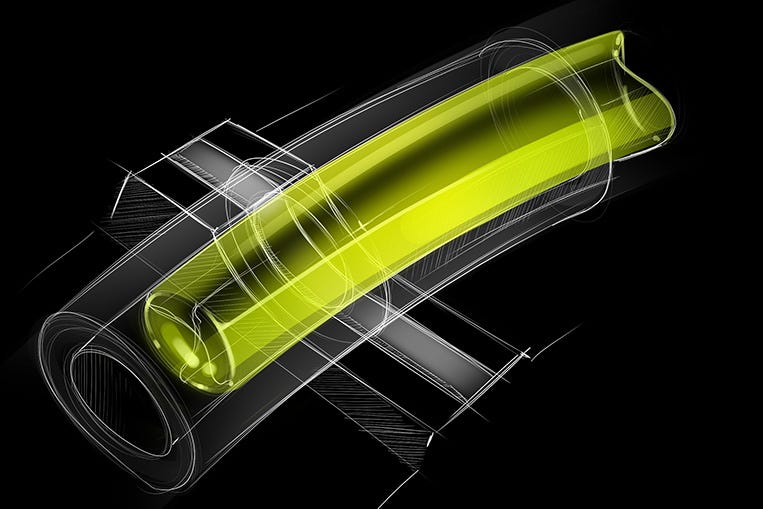
As the bellows compress and expand, the liquids move from the reservoirs and into the glass tube, which is built to tolerances of one micron
Much has been made of the HYT’s design, but the real artifice is in the engineering. Naturally, the watch world has spent decades refining ways to repel liquids and to prevent the utter heartbreak of a water-damaged watch. Here, HYT have succinctly engineered a waterproof circuit for the hour indicator, which runs to two reservoirs and then into the bellows. The bellows themselves are constituted from an electro-deposit alloy, designed to be highly resistant to liquid and to tensile pressure.
The hydrophobic effect keeps the fluorescein and the oil separate, whilst an almost invisible meniscus marks the divide between the two liquids
The cam engages and disengages the pistons against the bellows, and it is this alternating compression and inflation that impels the liquid fluorescein around the tube. The use of fluorescein itself must be a first for watchmaking, seeing as it is traditionally used in the forensic detection of blood. Predictably, even the tube itself is the product of some fairly rigorous micro-mechanics; it must be manufactured to a precise specification to allow for a tolerance that measures in the nanometres. So too, the reservoirs must only contain a critical volume, else this is a watch that simply would not keep time.
The whole capillary system is sealed from the rest of the movement; any slight deviance from the minute tolerances would result in disaster
The movement in the HYT H1 is built largely by hand, and the watches themselves have been produced in only very limited numbers, which imbues the HYT with the DNA of a supercar; at around $45,000 for the titanium incarnation, it’s also approaching the price tag of one. It is a truly beautiful yet unconventional watch and whilst it can claim to be the world’s first hydro-mechanical timepiece, its real triumph is that its startling form is to be found in its function.